


The European standardisation body CEN recently published a new reference document on AI professions: CWA 18398 “AI Professional Role Profiles and Educational Profiles”. It was developed by a working group made up of dozens of European organisations, universities and companies, and partly funded through the Erasmus+ project ARISA (Artificial Intelligence Skills Alliance).This is not a binding standard but a “workshop agreement” — a jointly produced framework intended to provide direction rather than impose obligations.
The purpose of the agreement is to provide a common language for roles, competences and educational needs in the AI workforce, in order to better meet the growing demand for AI professionals across Europe (the ICT skills gap is projected to widen from roughly 8 million to as many as 20 million professionals by 2030).
Core content
Definition of an AI professional: someone who professionally plans, builds, runs, enables, manages or governs AI systems — explicitly distinguished from “lay users” (non-professionals) and “professional users” (professionals who use AI as a tool without developing or managing it themselves).
37 role profiles, organised into 7 families: Data Processing & Analysis, Development, Operations, Support, Guidance, Management and Governance. Examples include Data Scientist, AI Architect, MLOps Engineer, AI Compliance Officer and Chief AI Officer.
Each role profile includes: a mission, tasks, deliverables, associated e-CF competences (European e-Competence Framework) with AI-specific proficiency descriptors, and personal/interpersonal skills.
Educational profiles (Annex C) translate these role profiles into learning outcomes, enabling education and training providers to design curricula aligned with labour market needs.
Strong links to the AI Act: attention to AI literacy (Art. 4), ethics, compliance-related roles, and a mapping between role profiles and AI Act actor categories (provider, deployer, etc.).
Builds on existing CEN frameworks: the e-CF (EN 16234-1), the ICT role profiles (CWA 16458) and the guidelines for ICT curricula (CEN/TS 17699).
The target audience for this CWA are HR departments and organisations (workforce planning), professionals (self-assessment/career development), education providers (curriculum design), students, and policymakers.
The document explicitly stresses that it is a “living” and illustrative framework rather than an exhaustive or definitive taxonomy — intended to evolve alongside the fast-changing AI field.
See more information below.
AI Professional Role Profiles and Educational Profiles (CWA 18398:2026)
In June 2026, the European standardisation body CEN published a new reference document on AI professions: CWA 18398. It was developed by a working group made up of dozens of European organisations, universities and companies, and partly funded through the Erasmus+ project ARISA (Artificial Intelligence Skills Alliance). It’s worth noting that this is not a binding standard but a “workshop agreement” — a jointly produced framework intended to provide direction rather than impose obligations.
The reasoning behind it is clear. AI is developing at breakneck speed and is becoming ever more deeply embedded in organisations, yet it remains far from clear what job titles such as “AI Engineer” or “AI Manager” actually mean in practice. One organisation understands these terms quite differently from another, which makes it difficult to recruit, train or compare people across the field. At the same time, Europe’s shortage of ICT professionals is growing sharply: from an existing shortfall of around eight million, this could rise to twenty million by 2030. The report attempts to address this by offering a shared language for AI roles, the competences attached to them, and the education needed to acquire those competences.
A central distinction the document draws is between people who simply use AI and professionals who actually build, manage or govern it. Someone chatting with an AI-powered chatbot is not an AI professional. But equally, a marketer who uses AI tools daily for trend analysis, or a doctor relying on a diagnostic decision-support system, is described in this framework as a “professional user” — someone who applies AI within their own field of expertise but is not responsible for designing or managing the underlying system. Only once someone plans, builds, runs, enables, manages or governs AI systems does the report consider them a genuine AI professional. A project manager who uses an AI tool to plan their own work is therefore a user; a project manager responsible for developing an AI application is an AI professional. This distinction isn’t always visible in job titles: someone might formally be titled “information security officer” while, in practice, largely fulfilling the role of an AI security specialist.
To bring order to this variety of roles, the report identifies 37 role profiles, grouped into seven families that together span the entire AI system lifecycle. Data Processing & Analysis and Development cover the collection of data and the building of AI systems. Operations and Support focus on keeping systems running and maintained once they’re in use. Guidance encompasses roles that provide ethical, legal and educational support, while Management deals with strategy and the steering of teams. Governance, finally, covers roles responsible for oversight and ensuring compliance with laws and regulations. Examples of roles include Data Scientist, AI Architect, MLOps Engineer, Chief AI Officer and AI Compliance Officer.
Each of these role profiles is described in a consistent format: a mission, concrete tasks, expected outputs (deliverables), the relevant competences drawn from the existing European e-Competence Framework (EN 16234), and a set of personal and social skills. This structure builds on earlier CEN work, such as the generic ICT role profiles (CWA 16458) and the guidelines for developing ICT curricula (CEN/TS 17699).
Alongside these professional profiles, the report also includes educational profiles, which translate market demand into concrete learning outcomes. The underlying idea is that education and training providers can align their curricula with what organisations actually need, rather than the other way round. Because a single professional role can be filled at different levels of seniority — a Junior AI Manager versus a Senior AI Manager, for instance — one role profile may correspond to several educational profiles, each linked to a level within the European Qualifications Framework (EQF).
Finally, the report draws an explicit connection to the EU’s AI Act. The role of AI Educator, for example, is linked to the Article 4 obligation to promote AI literacy within organisations, while the role of AI Compliance Officer is tied to broader compliance with the regulation. The document also provides an extensive explanation of how ethics, responsible AI use and risk management run through virtually all role profiles, not just those explicitly designed for that purpose.
The report itself stresses that it is not meant to be a definitive or exhaustive list of AI professions. It is intended as a living document — a snapshot of the current state of play — that will need to evolve as the AI profession continues to mature.
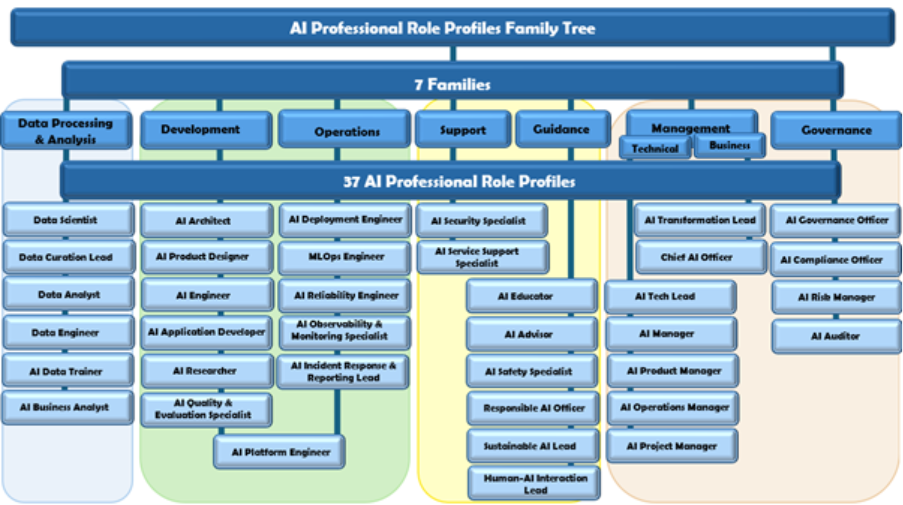
AI Professional Role Profiles Family Tree
Source: CWA 18398:2026 – “AI Professional Role Profiles and Educational Profiles”:


