


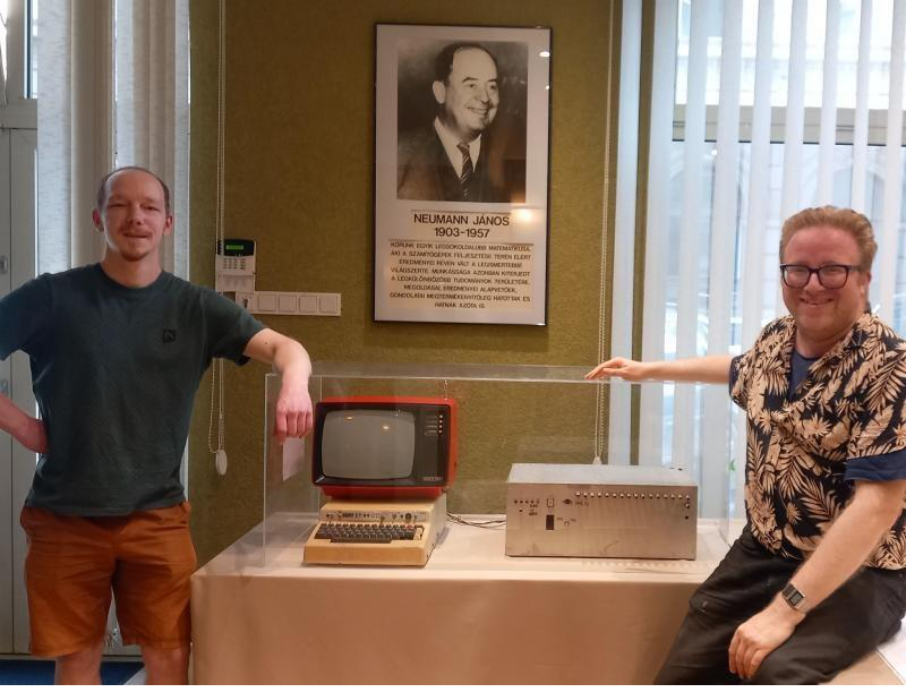
The John von Neumann Computer Society (NJSZT) has recently added remarkable relics to the collection of the IT History Museum Foundation, founded by NJSZT. Gábor Képes, Managing Director of the Neumann Society, received a long-lost treasure from the early era of home computers – now on display at the Society’s headquarters in Báthory Street, Budapest.
From the legacy of Endre Simonyi – a pioneer of personal computing in Hungary, founder and first president of the Hungarian Computer Constructors’ Club (HCC) – surfaced the metal case of one of his very first home-built computers (sadly without the original electronic components and circuit boards), along with the SWTPC CT-64 terminal used with the machine. These artefacts were generously donated to the Neumann Society by his son, Márton Simonyi.
Endre Simonyi was among the very first in Hungary to take an interest in the home computer revolution, starting work on his first machine around 1975. One could say that the personal computer was an “American dream” – but a Hungarian engineer recognised its potential and did everything to bring it home, not only introducing the machine category itself but also founding the club movement (originally Homebrew Computer Club – HCC) that, in the US, gave rise to many legendary microcomputer companies.
His first kit, built together with his father Márton Simonyi and Lajos Székely, was based on the Motorola 6800 microprocessor. The BASIC dialect developed by Simonyi could be loaded from cassette tape in 8 minutes. The computer took about two and a half years to reach its final form.
The newly acquired metal case with its accessories is likely part of Simonyi’s first (or one of his first) prototypes. This is supported by the fact that a close-up photo of the case appears in his article Let’s Build a Computer VIII (Mikroszámítógép Magazin, 1985/3, p. 29). Representing mid-1970s technology, the computer in its basic form had 128 bytes of memory, expandable to 16 KB RAM, a 16-channel analogue-to-digital converter interface, and a CPU card that could host multiple processors accessible via switching.
The configuration now on display can be seen at the Neumann Society headquarters in Budapest. The Hungarian HCC Club is also commemorated with dedicated showcases at the IT Museum in Szeged, complemented this year by colourful and interactive presentations during the “Night of Museums” programme. Today, HCC still exists as a special interest group within the Neumann Society, organising retro game programming competitions and public lectures.
In December this year, Gábor Képes, Managing Director of the Neumann Society, will give a talk on Endre Simonyi and the Hungarian HCC special interest group, titled We Need a Trabant in Computing!, at HaPoC 2025 – History and Philosophy of Computing Conference at RWTH Aachen University, Germany.


